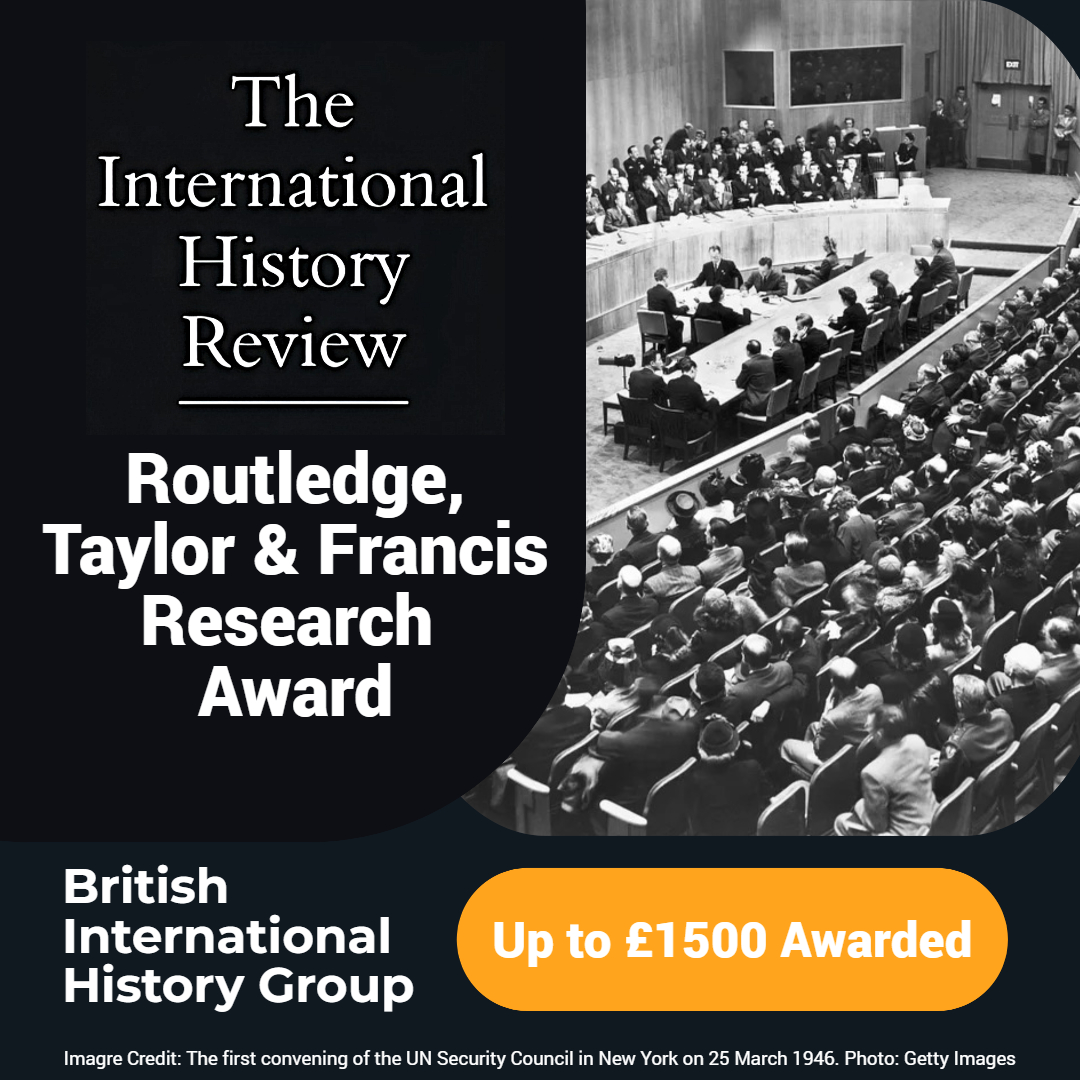
The International History Review / Taylor and Francis Research Award

The BIHG Thesis Prize was established in 1996. It is awarded annually to the best doctoral thesis on any aspect and any period of International History, which has been awarded a degree by a British University or a British University College or College of Higher Education during the calendar year.

Michael Dockrill

Eligibility: persons of any nationality who have a PhD or equivalent publishing record and who wish to engage in research into any aspect of international history.

Award: annually up to £1500 for expenditure on essential travel and subsistence to visit archives, conduct interviews or other fieldwork. The result of the award will be published online by Routledge, Taylor & Francis as well as the research output. Failure to submit an article to the IHR within the deadline will be noted publicly.

Criteria: judges will assess which application is likely to produce the highest quality article for submission to the IHR by applying standard article peer review criteria. The award is judged by members of the British International History Group Committee.

Submissions: to ihreviewprize@gmail.com by 30 September 2025.

Output: Minimum required output is an article which must be submitted to the IHR for consideration for publication within 18 months of the receipt of the award.

Report: required within 12 months of the receipt of the award of approximately 300 words on the conduct of the research and likely total outputs associated with the award. The report will be published online by Routledge, Taylor & Francis.

2025 Winner

The British International History Group is delighted to announce that the winner of the annual article prize, in collaboration with International History Review for 2025 is Dr Tia Culley. The title of her project is: 'Britain, the Commonwealth, and disabling NIEO demands (1975-1976)'.

Here is more information about the project.

This project is an outgrowth of archival research completed for a forthcoming book on President Ford and Anglo-American relations. It focuses on the British ‘Kingston Initiative’ at the 1975 Commonwealth summit. This was designed to court American favour, push the Ford administration toward multilateral negotiation, and to disaggregate the Less Developed Countries (LDC) in order to combat demands for a New International Economic Order (NIEO). Better understanding of this largely neglected initiative promises to challenge conventional wisdoms that in the mid-1970s Britain was enfeebled, LDCs were gaining economic power especially, and that it was the Ford administration that drove efforts to establish a post-Bretton Woods international economic system.

Research to date suggests that the Americans feared demands for a NIEO but were poorly placed, institutionally and temperamentally, to manage producer-consumer relations and therefore turned to Britain for help with this. The Wilson government also saw opportunities. First, the Kingston Initiative could foreground the significance of the Commonwealth and Britain’s continuing utility to the US by leveraging influence through the organisation. Second, it could boost British prestige and drain momentum from the NIEO initiative by disaggregating radical and moderate LDCs. Third, a successful initiative could enhance the effectiveness of British pressure on the Ford administration to adopt a more multilateral style in American foreign policy.

Ultimately, the Kingston Initiative was a relative success. Britian was able to demonstrate continuing international influence, and moderate producer economies were mobilised around a commodities plan more acceptable to the West. Importantly, too, US Secretary of State Henry Kissinger acknowledged that ‘a lot of sting’ was taken from LDC talk, and the Ford administration slowly accepted British arguments that key international challenges of the time required multilateral negotiation and solutions.